

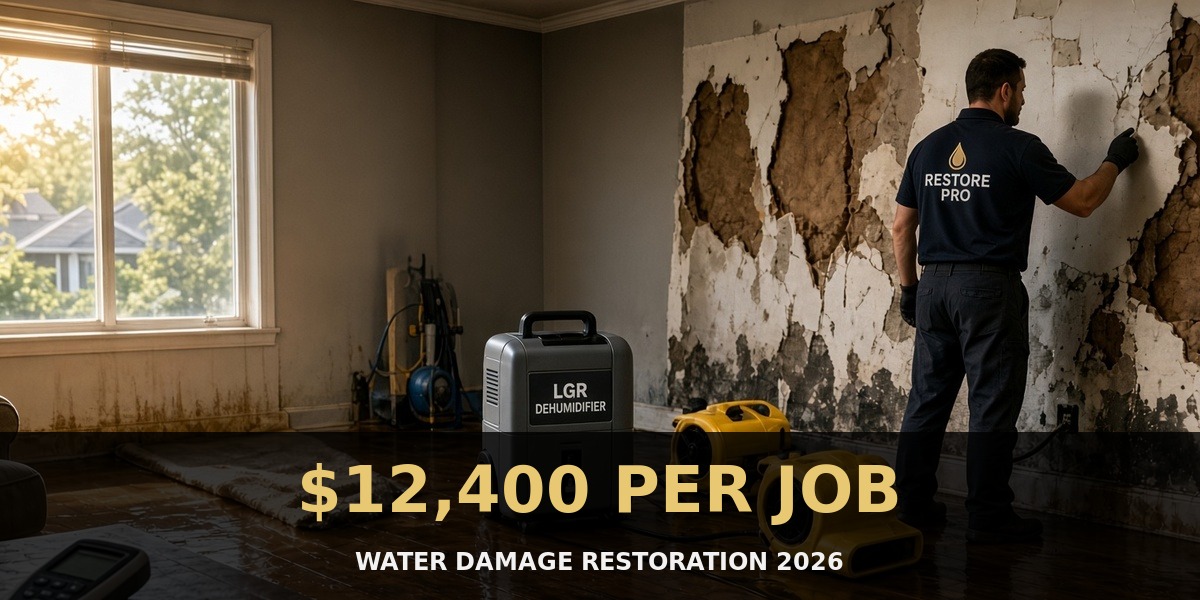
The $12,400 Job: Real Scope, Not Fantasy Pricing
The national average water damage restoration cost in 2026 sits around $3,000–$3,800 for a contained Category 1 clean-water event. $12,400 is not that job. It is a mid-to-large residential loss — two rooms plus a finished basement, drywall and flooring compromised, caught before a full rebuild.
Line itemWhat it coversTypical billEmergency water extractionStanding water, truck mount$1,400Moisture mapping + thermal inspectionMeters, photos, scope$350Structural drying (4–5 days)Air movers + LGR dehumidifiers$2,800Affected material removalWet drywall, baseboard, carpet pad$1,650Antimicrobial + mold preventionTreat cavities before close-up$650Contents pack-out / storageFurniture, textiles, electronics$900Limited reconstructionDrywall, paint, baseboard, trim$3,400After-hours / emergency dispatchNights, weekends, holidays$450Monitoring visits + dry-standard reportDaily logs for the adjuster$800Job totalMitigation + limited rebuild$12,400
That number is still conservative next to Category 3 black water, sewage backup, or a Class 4 specialty dry on hardwood and plaster — those routinely run $15,000–$30,000+ once mold remediation and reconstruction stack on top.
The Pricing Ladder Every Restoration Company Uses
IICRC S500 is the standard adjusters recognize. Learn the two grids or you will underbid every claim.
Water category (contamination)
Cat 1 — Clean: supply line, faucet, tub overflow. About $3–$7 / sq ft. Typical job $1,500–$5,000.
Cat 2 — Gray: washer, dishwasher, toilet overflow. About $4.50–$9 / sq ft. Typical job $3,000–$8,000.
Cat 3 — Black: sewage, river/flood, standing 48+ hours. About $7–$15 / sq ft. Typical job $7,000–$25,000+.
Damage class (how far water traveled)
Class 1: small area, low-porosity materials — 2–3 days dry
Class 2: full-room carpet and pad, walls wicked to ~24 inches — 3–5 days
Class 3: water from above; ceilings, insulation, walls, subfloor — 5–7 days
Class 4: hardwood, plaster, concrete, stone — specialty drying 10–14 days
The $12,400 job lives in Category 1–2, Class 2–3, plus limited rebuild. That is the sweet spot: high enough to matter, common enough to book every month in a wet metro.
The Exact Process I Follow on Every Water-Damaged House
Speed is the product. Mold growth can start in 24–48 hours. Insurance coverage shrinks if the homeowner waits.
Dispatch and safety. Confirm power, gas, and electrical risk. Category 3 black water means PPE before anyone steps in.
Inspection and documentation. Moisture meters, thermal camera, photos, and a written scope. This file is what gets the water damage insurance claim paid.
Emergency water extraction. Truck-mounted or portable extractors first. Every gallon pulled now saves a day of dehumidifier rental later.
Source control and containment. Stop the leak. Isolate clean rooms. If mold is already visible, switch to IICRC S520 mold remediation protocol with containment.
Remove what cannot be saved. Saturated pad, swollen drywall, contaminated insulation. Do not “dry and pray” Category 3 materials.
Structural drying. Place air movers and LGR dehumidifiers. Log temperature, RH, and grain depression daily until wood is under ~15–17% moisture content.
Antimicrobial treatment. Treat cavities and remaining surfaces so the rebuild does not trap odor or mold.
Contents restoration. Pack-out, clean, and store salvageable furniture and textiles. This line alone adds hundreds to thousands.
Rebuild and closeout. Drywall, paint, flooring, final moisture readings, and a dry-standard report for the adjuster.
What Actually Makes This the Highest-Paid Cleaning Niche
